Loading Viewer…
Category: Articles
Loading Viewer…
Loading Viewer…
Loading Viewer…
Loading Viewer…
Loading Viewer…
Loading Viewer…
Loading Viewer…
Loading Viewer…
Loading Viewer…
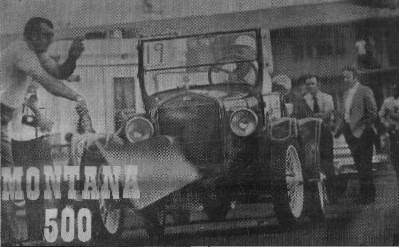
Across Montana’s highways streaks car #21 ahead of the pack in the Montana Model-T Cross-country Endurance Run. What an envious position for Association President, Al Rieker, Overcast skies, the wind at his back, first place was in the bag with an eleven minute lead and 542 miles behind him. Thirty miles to the checkered flag and thunk the crank shaft broke putting Al out of the running. Al’s breakdown wasn’t the only one, but certainly the most dramatic when twenty seven Ford T’s were pitted against Montana’s mountains & plains.
The Montana Model T Cross Country Endurance Run has been called many things. From the Great Montana T Race to the “T” Model Marathon. With coverage in such distinguished publications as Road & Track, The Vintage Ford, and Rod & Custom,thjs endurance run has grown to International fame.
The 13th Annual Model “T” Endurance Run started at 9:00 A.M., June 27, within sight of the Capitol Building at Helena. First stop Great Falls for lunch, then on to Havre, where the Ford “T”s tied up for the might.
The first day was not without it’s trials. Car #4, driven by Phil Polillo never got out of sight of the Capitol before a rod gave out. John Morris, Phil’s partner, brought up the trailer and the car was taken to Havre, rebuilt that night. The team was given slow time for the day and time penalties. Car #4 faulted again the next day 20 miles out. The “T” lost its oil, overheated badly losing compression. Phil and John decided to leave the race, but plan to return next year.
The first day saw five more cars go under as the Fords followed interstate 15 along the Missouri River. John Foos with #12 was out of the running, but by the noon lunch plans were already formed to use #12’s differential in Norm Eberhardt’s car #27, who also broke down.
By the end of the first day the Fords had run themselves out of the Rockies into the Montana Highline Country at Havre. Spending the night here, the Association drivers and officers met that evening for a briefing on the run for the next day. Afterwards Clement Englmann of Chicago, Ill., treated the Association to a motion picture spectacular covering last year’s Endurance Run and other events. Mr. Englmann had some of the best footage I’ve seen.
The second day saw the “T”s off Thursday morning running the Highline to Harlem, then to Lewistown and Harlowton for the overnight stop. The Highline Country affords the drivers the most freedom as the roads are flatter, straighter, and with less traffic. A hundred miles or more of T Roadsters trying to pass one another nip and tuck jockeying for time. many an enthusiast enjoyed this “out take” of a 1927 movie.
It had become overcast and the Fords drove into a down pour outside of Harlowton before tying up for the night In Harlowton the club was treated like royalty. The Chamber of Commerce put on a banquet, gave trophies and cash prizes, gave a tour of the town and stored the “T” cars out of the elements. It’s co-operation like this that makes the event. The last day the pack left Harlowton for a half day run into Helena, then stopping at White Sulpher Springs where the Jaycees gave the club a free coffee break. Next to Townsend then to the finish line.
Al Rieker from Boulder, Montana, lost his 1st place lead when his crank shaft broke and the Californians took the checkered flag. 1st place Scott Rawlings, 2nd John French and 3rd Jack. Collins. All three were from Lancaster, California.
In the Cast Classification was lst place Perry Matthews, 2nd Rich Armstrong, and 3rd Bill Shipley.
The tear downs themselves took about one hour and are very detailed. The pan, head folding windshields & other points not to be opened without the judges knowing are sealed before the race. A team of inspectors check each car meticulously, if any discrepancy appears they are disqualified and more cars are torn down until winners are confirmed. Last year three cars in the aluminum class were disqualified before winners were confirmed. This year there were no disqualifications. Mandatory tear downs are a key point here. By being club rules, no member has to challenge another. Hard feelings are avoided, unlike some clubs that require one person to post tear down bond to inspect another.
Needless to say these are not the bailing wire junkers that some would lead us to believe. Mechanically, they are perfection in stock “T” Fords. Sometimes the crank and trans are sent as much as 1500 miles away for balancing. We heard of differential gears and cranks, chrome plated to reduce friction. Of course you can always get a conversation going on the pros & cons of different types of banding material, they have tried them all.
The ability of men and cars is testified by over 14,000 miles driven in three days by 27 different drivers without an accident or traffic violation.
The top four cars in each class went to the mandatory tear downs at Placer Motors, Helena. The rest of the T’s gathered at the fairgrounds, where the trophies were later presented. A very accommodating Placer Motors moved four new Olds in order to make room for the Model “T” Club tear downs in front of their showroom.
All of the Association met at Bairs Truck Stop in Helena where arrangements had been made. The club enjoyed a fine meal in the Banquet Room before splitting up for the trophy awards.
At the Helena Fairgrounds the trophies and cash prizes were handed out with due ceremony and a keg of beer. President Al Rieker presiding. During the many interviews I never spoke to a club member that wouldn’t be back next year.
After the awards were over and I walked back to my truck thinking of the past three days, I thought brotherhood would be a better word than association for these guys. The acts of friendship, good sportsmanship, and yes, even heroism displayed in these 572 miles so typified the old car enthusiast. It’s no question but what the Montana 500 has earned its honorable place in the annuls of Model “T” History.
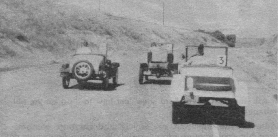
Skys are big in Montana and the impossible sometimes happens. Recently, while touring in the eastern part of the state, I was astounded to see a pack of ancient Model T’s dashing madly down the highway. I fell in behind and watched as some fell back and others struggled valiantly to hold their position. After watching them for some time – racing along at top speed – I passed and went on to the little town of Terry. On the street there were TV Cameras and about half of the population of the surrounding countryside. They were waiting for the famous “Montana 500 Model T Cross Country Race”.
The Race (really an endurance contest) was organized in 1961 by Mr. Ed Towe, a banker from Circle, Montana, and a group of local people interested in old cars. Each year the race is run over a different route of approximately 500 miles, with cars starting at one minute intervals. They go a pre-determined number of miles each day over a three day period.
When I stumbled upon them they had already completed 475 miles over a course starting at Miles City, going through Baker, on to Glendive, North of Sidney and Plentywood – then West to Scoby and back South through Wolfpoint, Circle, Glendive, Terry, and finishing at Miles City – making a huge 540 mile figure eight.
At Terry the drivers were demolishing trays of doughnuts and gallons of coffee and lemonade, all furnished by the Bank and the Local Ford dealer.
On coffee breaks and at night, time-out is taken. I was informed that the drivers would take-off in about 30 minutes for the finish 35 miles away. Being completely fascinated, I changed my course and proceeded to Miles City to see the finish and learn more about the outcome.
Twenty five cars started in the race and 22 were still running at the finish.
Rules of the race stipulate that these cars shall be examined before the start for safety and to see that they are in original stock condition. Many of the components on the cars are sealed and the seals must still be intact at the finish I they are not intact, a time penalty is assessed. The fastest six cars (three in each class) using aluminum or cast iron pistons are torn down in a local garage and must pass through a check to see that parts have not been modified.
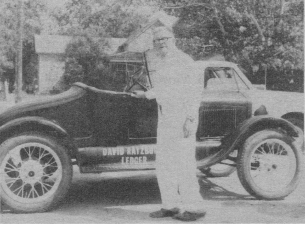
At this year’s race, the fastest 3 cars in the aluminum category had certain modifications which disqualified them. The next in line were examined and became the winners. First place in the Aluminum class was Dave Ratzberg, a farmer from Ledger, Montana. His time was 10 hours, 51 minutes 12 seconds with an average speed of 51 miles per hour. Second place winner was Al Reckar, an ex-Chevrolet mechanic who now works for the State. He lives in Boulder, Montana. Third place was a tie between Doug Langley, a wheat and barley farmer from Rudyard, Montana, and Don Endleman, a machinist from Chicago, Ill.
First Place in the Cast Iron piston class went to Richard Armstrong, President of the Montana Cross Country T Association. Second place was Ross Anderson from Arlington, Colorado. Third went to John French, a helicopter mechanic from Lancaster, California.
Model T’s competing in the Montana 500 came from California, Illinois, Washington, Colorado and Minnesota as well as Montana. About one hundred “T’ers” traveled along with the 25 racers. Wives and friends accompanied the racing cars in pickups, campers, trailers, house cars and car trailers. These T’s were driven by people from all walks of life, and their ages ranged from 19 to 79.
It is rumored that the 1973 Montana 500 may visit the town of Shelby in Western Montana.
A few notes about this article. It is supposedly written by Carl Bergman, but my records show Carl as having attended the run the year before (1971) and also as having run in 1972 and placing third in the cast iron division. John French was at the 1972 run, as I have pictures of his car. The text manages to misspell all four winners in the aluminum division, although the caption of the photo spells Dave Ratzburg’s name right. As near as I can discern, the cars in the left photo are Dave Meuli, Rick Carnegie and Cliff Hellwig, left to right. The article suggested that the 1973 run might go through Shelby – it didn’t.