Loading Viewer…
Author: mt500
Loading Viewer…
Loading Viewer…
Loading Viewer…
Loading Viewer…
Loading Viewer…
Loading Viewer…
Loading Viewer…
Loading Viewer…
Loading Viewer…
Montana Cross Country T Assn.
7516 E. Mission Spokane, WA 99212
www.antiqueautoranch.com/montana500
2001 Officers and Directors:
President: Sam Nickol
Vice President: Rick Carnegie
Sec.-Treasurer: Janet Cerovski
Directors:
Tony Cerovski
Stan Howe
Doug Langel
George Nickol
Simon Nickol
Meeting Secretary: Carla Carnegie
Correspondence: Tom Carnegie
Membership dues $10.00
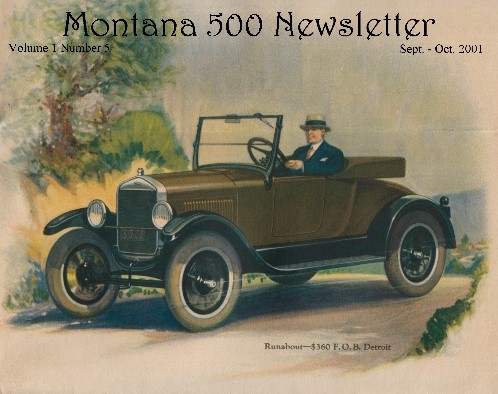
Cover picture: Original Ford ad for 1926
General News
The fall meeting will be held in Missoula this year at The Joker’s Wild 4829 N. Reserve. The date is Sunday, October 28th, 11:00 AM. We have the “room upstairs” reserved for us. We can order lunch at 11:00, and start the meeting as soon after that as we can. All members are urged to attend. Any rule changes and routes are proposed at this time. The Speedvision program was aired, and was enjoyed by many. I invited them to come back next year with more cameras crew and film. The printer cut off a paragraph on my summary in the last news letter. The full text appears on the web page. I was upset that I didn’t catch the mistake earlier because it was the part where I thanked the flaggers and timers for this year’s event. Thank-you again timers and flaggers. You did an excellent job. There are no drivers profiles this month, due to the length of the technical article. I will have more next time I believe. Some of you members have excellent writing skills. Please pick up a pen, and write a profile on a driver that you know. I and the other members would very much appreciate it. I’m not going to mention that I still haven’t found the results for 1963 & 1971, as it would just depress me.
A poor man’s balancer
by Tom Carnegie
One of the major tricks to making an engine run fast is to make it run smooth. With a Model T, this is a difficult task for several reasons. First of all, a four-cylinder engine without balance shafts will never run in true balance. This is because when the crankshaft is half way down (90 degrees off of top dead center) the pistons are more than half way down. The pistons actually move faster on the top half of their travel than on the bottom half. This may be hard for some people to visualize, but it is the case. One thing that sometimes helps illustrate this is to imagine an engine with its rod hanging loose. If you were to pull the piston exactly half way down the bore, and continue to let the rod hang, the crank hole in the rod would exactly line up with the main line. If you would turn the crank to its halfway point, it would be 90 degrees from top dead center. Now, if you were to hook the rod to the crank, without turning the crank, you can see that you would have to pull the piston down slightly to get it to hook up, as you swing the rod toward the crank. Having said all of that, there is a couple that occurs twice per revolution that can’t be relieved under normal circumstances. It can be mitigated though, by using the lightest rods and pistons that you can find. A couple is a rocking motion. A good example of a couple is two kids on a swing set. When one is forward, the other is back and vice versa. The force put onto the upper bar of the swing set is a “couple”. Other reasons for the balancing difficulty of a T engine have to do with the transmission. There are many parts like drums and clutches that move around, making a true balance all but impossible. Still, the closer you can get everything else, the better. This article will tell how to build a very accurate dynamic balancer for almost no money.
Balance, do!
For the assembly of this machine, you will need the following items:
- 3 – junk T engine blocks
- 4 – used T generator bearings
- 2 – Pieces of 2″ angle iron 3 1/2 inches long each
- 5 – 3/8″ X 1″ NF bolts
- 8 – 3/8″ flat washers
- 4 – 3/8″ lock washers
- 7 – 3/8″ NF nuts
- 2 – 7/16 X 3/4″ NC bolts
- 1 – No. 10 – 32 X 3/4″ machine screw
- 1 – old 28-9 Model A or Model T bumper bar
- 1 – 3-lb. coffee can with lid.
- 1 – 3/8″ rod 7-1/2″ long
- 1 – circle of tin 5″ in diameter
- 1 – circle of tin 3″ in diameter
- 1 – set of distributor points
- 1 – ignition coil and coil wire
- 1 – condenser
- 1 – timing light
- 1 – battery to operate timing light and coil
- 1 – 1″ by 8″ long piece of strap iron
- 1 – 1/4″ diameter rubber bumper
- 1 – 3/8-drive variable speed drill motor
- 1 – an old starter or generator case
- 1 – 1/4″ ball bearing
- 1 – dial indicator
Scallop both pieces of angle iron as per the illustration. (fig 1.)

Drill two holes into each piece, for the bearings, and tap to 3/8″ NF. Drill a hole into the center of the bottom of the piece of angle iron large enough for a 7/16″ bolt. Into one of the two pieces, drill and tap a number 10 X 32 hole into the bottom front of the angle iron, as per the illustration. Bolt the bearings onto the angle iron pieces. (See pic. 2.)

pic. 1

pic. 2
The bearings need to be very clean, and must spin freely. Put a drop of oil into each bearing. Cut the bumper into a section 20″ long, and drill a 7/16″ hole 3/4 of an inch from each end. Bolt one roller assembly loosely to one of the T blocks. Bolt the bumper section snugly to another of the T blocks. Bolt the other roller to the other end of the bumper, loosely. Space the rollers out so that a Model T crankshaft will roll on the first and third main. (As per pic. 1.) Adjust the roller assemblies so that they are running true on the crank main, and then tighten them. Spin the crank clockwise, looking from the spring end. If the crankshaft “walks” left or right, move one of the blocks forward or back and try again. Carefully adjust the crankshaft until it spins freely, and just creeps to the left as it is rotated clockwise looking at the end that is sitting on the spring (the bumper piece). Put some grease on a 1/4″ ball bearing and stick it into the end of the crankshaft. Butt the ball up against the generator housing that you have sitting on the block. (See pic. 1) Place something heavy onto the generator housing to keep it in place. It is also handy to thread a bolt into the block for the generator case to butt up against to keep it from moving. Most unbalanced T cranks I’ v e tried will come to rest in heavy-part-down position if you set them on the rollers at this point. The next thing to build is the dashpot. What this does is dampen the action of the spring somewhat. It consists of a disk on a rod in a can of oil. (See fig 2)

You can make a couple of different sized disks to change the sensitivity of the balancer. The next thing to do is to make the point setup. Take a piece of 1″ strap, and twist it 90 degrees near the end. (See pic. 3)

pic. 3

pic. 4
Drill a 7/16″ hole near the end, to bolt the assembly to the block. Mount the points and condenser on in the manner of pic. 4. The machine screw needs to be adjusted so it is a few thousandths of an inch from the points when the item to be balanced (henceforth called the rotor) is in place . Wire a coil and battery to the points, and attach your timing light to the coil wire in the correct manner. Let the coil wire spark to ground in some convenient place. Don’t apply electricity to the coil until you are ready to begin balancing, as leavin g the electricity applied to the coil could cause it to overheat.
A Balancing Act
In order to balance the rotor, it must be spun. The way I do this is with a variable speed electric drill. Place a pointed piece of rubber into the drill, and the rotor can be spun by placing the rubber into the center on the end. Now, the cool thing about this balancer is that it can balance in two planes. I will explain what that means. Some people refer to dynamic and static balance. Please refer to pic. 5.

pic. 5

pic. 6
That is an axle shaft with a bolt welded onto it. If you were to gently spin the axle, it would always come to rest with the bolt down, as it is in the picture. Now, look at the axle in pic. 6. It has another bolt at the other end of the shaft welded just opposite the first bolt. However you turn this shaft, it will stay in that position. This is what some folks refer to as static balance. I do not like this term, as any static shaft has reached equilibrium, and therefore by definition is in balance. In order to be out of balance, the shaft must be turning. I prefer to use the term “balanced in one plane” or “balanced in two planes” in exchange for the terms “static” and “dynamic” balance. It is easy to see that if you consider the axle in pic. 6 as one plane its entire length, that it is in balance. If you divide the axle into two planes, a right plane and a left, splitting the axle figuratively in the middle, it is easy to see that each plane is quite out of balance, just as the axle in pic. 5 was. Our quest is to get our rotor balanced in two planes. To accomplish this, we balance it one side at a time. The rotor we are talking about in this case, is the crankshaft, which should be balanced with the pulley and crank gear on it. As I mentioned earlier, when you place the rotor into the machine, it will probably come to rest in the same place every time you spin it. In fact, it may be so out of balance, that even at a moderate speed of rotation, it will try to jump out of the rollers. What I do, is to get it into reasonable balance in one plane first. Note the heavy spot. It will likely be two of the four rod throws. Grind or drill away some metal on the heavy spots, and try again. At a point in time, the rotor should stay at any position you put it. You are now ready to begin balancing in two planes. Use the large dashpot disk at first. As the rotor comes into better balance, substitute the small disk for greater sensitivity. On the end of the rotor make three marks as per fig 3.


fig. 3 fig. 4
Place a dial indicator on top of the spring as in pic. 1. Spin the rotor, and adjust the point screw so that the timing light just flashes at the point of maximum imbalance. This point can be noted on the dial indicator. As you spin the rotor, it will be relatively smooth, then will become rough, and then will smooth out again. There is no need to spin it above the speed at which it smoothes out. Spin the rotor up, and as it slows, watch the flashing of the timing light. One of the marks should appear to stand still 90 degrees to the right of top (1. in fig 4) then, as the rotor slows, the mark will appear to rotate anti-clockwise until it is at the top when the point of maximum vibration is reached (2. in fig 4). As the rotor continues to slow, the mark will appear to rotate 90 more degrees to the left as the rotor slows to below the imbalance speed (3. in fig 4). Where the mark appeared at the moment of maximum imbalance is the light spot. That means that you need to take off material opposite this and in the plane in which you are working. There are two rod throws in each plane, and normally one of these will be down when the balance mark is up. If it is the rod throw closest the end, you will have to take off less material than if it is the other, as it is farther out on the plane we are balancing at this time. After a few times, turn the rotor end for end and balance the other plane for a while. As you get the rotor closer and closer to being in balance, you may encounter the situation where the rod throws are parallel to the ground. When this happens, you must drill the flange or the timing gear or the pulley. When you get to the point that the dial indicator is only moving one or two thousandths of an inch at the roughest spot, then you are probably close enough. The machine I built was admittedly a little crude. With a little adapting, a permanent machine could be made to do a whole host of balancing projects. I built mine out of old T blocks because they were handy, and quick. It was also an experiment, but it worked well enough to give me incentive to refine it, and perhaps make it more permanent.
A question of balance
They say the proof is in the pudding. When I got to the point that my rotor was only out of balance a few thousandths on the indicator, I decided to see just how good it was on a commercial machine. Jack Bunton of Vintage Engine Machine, has a Stewart-Warner precision balancing machine, which he kindly let me use to check my work. The scale on his machine goes from 1 to 10. Anything under 1 is considered acceptable. My crank registered just two tenths. This is the level of balance that you would expect on high revving racecar motors. The pudding is quite good indeed, and inexpensive too.
Montana Cross Country T Assn.
7516 E. Mission, Spokane, WA 99212
2001 Officers and Directors:
President: Sam Nickol
Vice President: Rick Carnegie
Sec.-Treasurer: Janet Cerovski
Directors:
Tom Carnegie
Tony Cerovski
Stan Howe
Doug Langel
George Nickol
Simon Nickol
Meeting Secretary: Carla Carnegie
Correspondence: Tom Carnegie
Membership dues $10.00
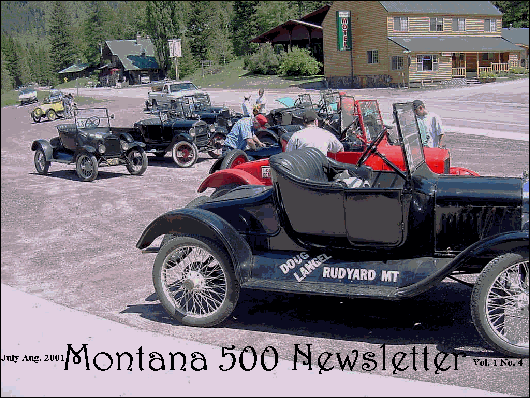
Cover picture: East Glacier, third day of 2001 Endurance Run. Picture taken by Paul Marx.
Page 2
General News
The 2001 endurance run is over. It was won by Ron Miller. Ron is my kind of model T guy. I understand that he had his head off his motor 17 times, the last time in the parking lot at the hotel before the race. I on the other hand broke my seal from the year before only because I couldn’t get my car to go onto the trailer. I have vowed to be better prepared for next year!
Normally the number after your name indicates through what year your dues are paid. I have not updated after the race, so some people’s numbers may be out of date. I will try to get synched up with Janet by the next newsletter.
The people from ESPN were there at the race, video taping. The show is scheduled to air August 13th on a show called “Car Crazy”. If you have cable, you might want to check your listings to find out when it will be shown.
This month, I have two more driver’s profiles, including one written by the cast-iron champ, Rich Armstrong. Rich is not made of cast-iron, but his T had pistons made of cast-iron for many years.
If anyone has photographs of past years that they can scan and e-mail to me, I would love to put them on the web page for all to enjoy. Speaking of the webpage, I still don’t have complete results for 1971. If anyone has this information, please let me know.
page 3
Compression Ratios
Here is some information that might be of interest to people. Thanks to Larry Young of Tulsa, Oklahoma for this. Larry cc’d various heads. These are the results he got. The total volume of the cylinder is 44.2 cubic inches. The total volume of the part of the piston that sticks up above the bore is 2.86 cubic inches. The head gasket holds .92 cubic inches. The total combustion chamber is the head volume minus the volume of the part of the piston that sticks above the bore, plus the volume of the head gasket. Using the stock head as an example: 17.9 minus 2.86 plus .92 = 15.96 cubic inches for the total volume of the combustion chamber. Cylinder volume plus combustion chamber volume divided by combustion chamber volume equals the compression ratio. (44.2 + 15.96)/15.96 = 3.77:1
The first number will be the head volume, the second will be the calculated compression ratio.
Stock head 17.9 = 3.77
Stock (milled 1/8″) 15.6 = 4.24
Waukesha-Ricardo 16.6 = 4.02
Z-head 13.7 = 4.76
Z-head (milled .050″) 12.8 = 5.07
Reeder 12.2 = 5.31
Now the same figures for an engine bored .060″ over.
Stock head 3.86
Stock (milled 1/8″) 4.34
Waukesha-Ricardo 4.11
Z-head 4.88
Z-head (milled .050″) 5.2
Reeder 5.44
Page 4
Summary of 2001 Montana 500 Endurance Run
by Tom Carnegie
Sunday was inspection day. Somehow the local newspaper had printed an article saying that the run proper began on Sunday, a misapprehension shared by some of the T drivers. Better too early than too late I guess. After we had inspected all the cars, we had our evening meeting and drew numbers. Rick Carnegie, last year’s winner was number one, and Rob Flesner, a newcomer this year, was the last car (a position he held the entire way) with number 18. We had four more or less touring cars. Peter Proschold from Las Vegas with his brass touring car, David Lingle with the roadster his dad Melvin drove, Keith Painter from Bountiful, Utah and Simon Nickol with his touring car. David and Simon had a little trouble, and didn’t tour with us too much, but Keith and especially Peter drove a lot of miles. I wouldn’t be surprised to see Peter back next year with a racer. Simon helped out with the trouble unit throughout the run. Monday morning in the rain, we headed out for Whitefish to flag out. The first leg saw the first T break down. It was Ted Ballard with rear axle troubles. Ted was driving a car that used to belong to Orrin Culross of Culver City, California. Orrin used to race in the mid ’70’s. The next casualty was on leg three when Tom Carnegie’s crankshaft broke. Tom was in second place at the time. The rest of the first day was uneventful, until after the last leg, Nan Robison’s rear axle started making funny noises. Since Tom’s car was dead in the water it was
(Continued on page 6)
page 5
(Continued from page 5)
decided to cannibalize it. The rear axle assembly got put into Nan’s car, the radiator was put into Mike Robison’s car, as he had had radiator trouble all day, and the coils went into Rob Flesner’s car, as he had had coil trouble.
Day two saw the next catastrophe. Nan Robison’s car lost a magnet, which seized up the motor, just as she was attempting to pass a truck. Josh Billmayer was right on her tail, but managed to somehow avoid hitting her as she skidded to a stop along side of the road. Nan was in sixth place at the time. About noon, the crew from ESPN showed up and began to record the action. They stayed and taped until the end of day three. At the end of day two, Ron Miller was out in front followed by Doug Langel, then Steve Coniff.
Day three saw the last break down. Mike Robison’s borrowed radiator couldn’t take the stress, and blew up. Mike had to quit with just two legs of the run left to go. Mike was in tenth place at the time. Also on the third day, Harold Mann withdrew to tour Glacier Park. Harold was in fourteenth place at the time. During the course of day three, Steve Coniff and Doug Langel swapped places. After all the times were compiled, we had a driver’s meeting where we decided against having a post-race tear down. President Sam Nickol presented Ron Miller with the first place trophy. Dave Huson generously donated a trophy for the best place finish by a female. It was awarded to Anna Marx. Anna finished tenth overall.
All in all, it was a great run, with good weather, a superb route and excellent timing and flagging. We had more entrants this year than we’ve had since the 1980’s. Next year we look forward to an even better Montana 500!
Page 6

page 7
John Foos
by Rich Armstrong
John Foos was reared in Laurel, Montana, but now resides in Helena. John entered his first race in 1961. He competed in the last two days of the Missoula to Circle race promoting Highway 200 through Montana. After the Montana Cross-Country “T” Assoc. was organized, John joined and participated in thirteen races through the 1980’s.
John was a fierce competitor! His motto-” I CHEAT”. This was more bluff than anything, as his generosity was very evident in that he never refused to assist anyone-
whether it is the need for a coil or EVEN the loan of a complete engine!
John served as President in 1966 and 1967. His wife, Donna, was Sec.-Treasurer.
Spontaneous response was one of John’s characteristics. During a race in the Flathead country, the weather was cold and very rainy. After two days of driving with no top on his roadster, and while stopped for coffee and trying to find shelter from the elements, a
young man driving a Model A Sedan stopped. He leaned out the window and asked John
if he would trade. John jumped up and said, “Get your junk out and you have a trade”.
Five minutes later, John was a proud owner of the A. John’s comment when asked why
he did it; “At least I’ll be dry”!
Page 8

page 9